Juno Beach Turtle Hatching Season Happening Right Now
August 20, 2026
August 20, 2026
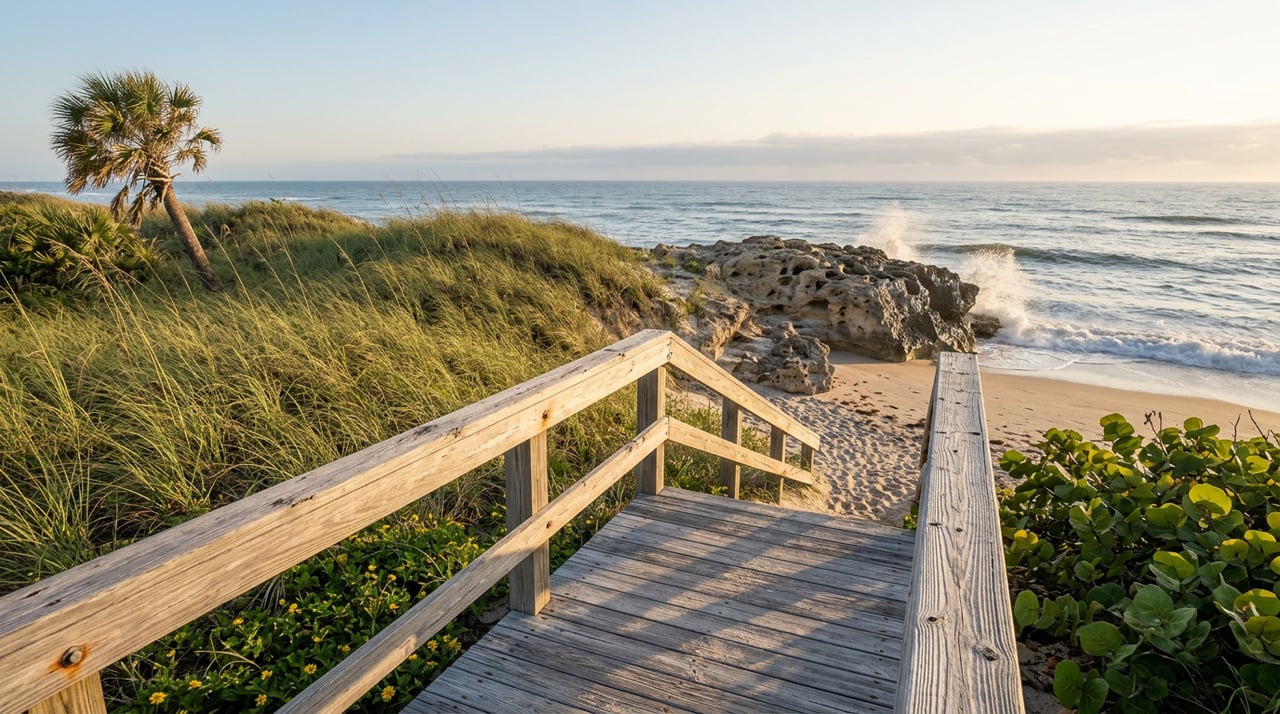
Walk out to the Juno Beach Pier after dinner this week and the beach will feel different than it did in June. Back then, the sand belonged to something quiet and slow: a two-hundred-pound loggerhead easing up from the surf sometime after nine, digging for the better part of an hour, then vanishing back into the dark. Now, in mid-August, that same stretch of sand is doing double duty. Somewhere down the beach, a female is still nesting. Somewhere else, a nest laid back in June is already cracking open, and two-inch hatchlings are making their run for the water. Most people who live here think of "turtle season" as one long, undifferentiated stretch from spring through fall. It isn't. It's two separate seasons stitched together, and from August 1 into October, they overlap.
That overlap is the reason your porch light matters more this month than it did in July, why the after-dinner walk takes on a different shape, and why the rules for what you do if you find something in your path depend entirely on what you found.
Sea turtle eggs take roughly 50 to 60 days to incubate before hatching, a timeline tracked closely by conservation groups working this stretch of coast. That gestation lag is what creates the overlap. A female nesting in June won't have hatchlings emerging until late July or August. A female nesting in September won't produce hatchlings until well into October. Because nesting continues on this beach through October 31, and because the earliest clutches from early summer are already hatching, mid-August is the point where both processes are running side by side on the same sand.
Loggerhead Marinelife Center, the Juno Beach nonprofit whose campus sits directly on the beach at 14200 US Highway 1, documented the earliest nest in its monitoring history on February 11, 2026, weeks ahead of the official March 1 start date. Justin Perrault, the center's vice president of research, attributed the early activity to warming ocean water. In 2025, researchers there logged 20,871 nests across leatherback, loggerhead, and green turtles, a scale that gives some sense of how much is happening on this coastline in a single season. Loggerhead hatching specifically peaks in August and September, which is exactly why this window, not July, not October, is when the two clocks run together.
You can see the overlap reflected in the center's own schedule, which effectively splits the season into three distinct offerings rather than one continuous event:
Only during the August-to-September program window do all three run concurrently. That's not a coincidence of scheduling. It's the biology catching up with the calendar. The center also narrowed the stretch of shoreline it monitors directly this year, focusing on 8.5 miles of the densest nesting activity, down slightly from 9.5 miles in past seasons, with the Florida Fish and Wildlife Conservation Commission covering the remaining section of northern Palm Beach County.
The practical difference between the two halves of the season is what you're supposed to do when you come across something on the sand after dark. They're not the same situation, and the guidance isn't interchangeable.
| If you encounter | This time of year | What to do |
|---|---|---|
| A nesting adult | Still possible through October | Keep your distance, stay quiet, no lights or flash photography, let her finish undisturbed |
| A hatchling | Increasingly likely through September | Let it crawl to the water on its own, do not pick it up or redirect it by hand |
| A disoriented hatchling headed away from the water | Most common in August and September | Bring it to the 24-hour rescue cooler at the Loggerhead Marinelife Center entrance |
The Florida Fish and Wildlife Conservation Commission's guidance is consistent on this point across the state, and it's worth actually knowing rather than assuming, because a well-meaning instinct to help can do the opposite. Digging a hatchling out of the sand or carrying it to the water yourself removes the imprinting process it needs to find its way back to this same beach roughly two decades from now to nest.
The behavioral asks that come with this stretch of the season are small but specific: lights off or blinds closed at night, beach chairs and canopies brought in before dark, holes filled back in, sandcastles knocked down. Those aren't generic beach etiquette. They're direct responses to a hatchling's navigation, which relies on finding the brightest horizon, historically the reflection of moonlight on open water, and gets thrown off by a porch light, a flashlight, or an obstacle in its path.
There's also a broader shift worth knowing about if you're on the water at dawn or dusk. Palm Beach County recently expanded its voluntary Sea Turtle Protection Zone to cover the county's entire 45-mile coastline, extending a mile offshore, and it asks boaters to slow down and stay alert given the volume of turtle activity just beneath the surface this time of year.
The pier itself remains the most visited access point, and the beach directly around Loggerhead Marinelife Center's campus sees the heaviest nest density, which is part of why the center is headquartered there in the first place. If you'd rather experience the season from the dunes than the sand, Bert Winters Park at 13425 Ellison Wilson Road serves as the access point into the south tract of Juno Dunes Natural Area, a 576-acre preserve of trails cutting through sandy scrub just across Ellison Wilson Road.
If you catch a morning Hatchling Discovery program rather than a nighttime walk, the timing works out well for breakfast afterward at the small cluster of restaurants near US-1 and Donald Ross Road, an intersection locals already treat as close to a downtown even though it's never been formally named one.
Worth knowing too: the center's guided programs aren't confined to Juno Beach itself. Staff also lead excavations and beach ecology talks on Jupiter and Tequesta beaches under the same state permits, so if you're weighing which evening to plan around, the options extend a little further up the coast than the campus address might suggest.
None of this lasts. By late September the excavation and release programs wind down, and by October 31 the official season closes entirely, though this year's unusually early February nest is a reminder that the calendar bends more than it used to. For now, this is the stretch where the beach is doing the most work it will do all year, quietly, mostly after dark, with two overlapping processes that most people walking past never realize are running on different clocks.
If you're weighing a move to this stretch of coast, or already live nearby and know someone thinking about it, Leila Kallop brings the kind of local fluency that comes from actually living the rhythm of these neighborhoods, not just marketing them. You can explore more about life in Juno Beach or request a private consultation to talk through what a home here, and a season like this one, actually looks like day to day.
Stay up to date on the latest real estate trends.
Leila has been a Jupiter Island resident since 2011 and brings a deep understanding of the island’s luxury waterfront properties. Residing on South Beach Road provides her a unique perspective on what makes Jupiter Island real estate so exceptional.
LEILA KALLOP
WILLIAM RAVEIS REAL ESTATE
2 S Beach Rd
Jupiter Island FL 33455